A Rambling Introduction
I’ve just, slightly prematurely, reached the end of my third solo tour for my latest show “We’re Not Getting A Dog”. Premature because I had to cancel the final three performances because I got tonsillitis and can’t speak for longer than ten minutes which, for a show with a seventy two minute running time, is fairly problematic.
It was my longest tour to date, my most successful, but also, by far, the most challenging for a myriad of reasons. I tend to find, observing the theatrical world, that it’s very rare that productions are put under a microscope fully – it can feel like an incredibly vulnerable position – as if admitting any failing is a death sentence or might lead to banishment from UK Theatre (as if that’d necessarily be a bad thing). On the contrary, I think that talking about it makes it stronger.
So, this is going to be blunt, to the point, a little brutal, and I’m going to share the warts and all. As part of this you’ll discover why this tour being my most successful is a dubious claim to fame, why I am the quintessential unreliable narrator, but also why the premature ending – cancelling three shows I was really, really fucking excited about – has been softened by an unexpected bit of feedback. So yes. Strap in.
Oh, and before I begin. I’ve written a load of subheadings here – if you read this and want to grab a chat then send me a Linkedin message. Always happy to help.
Artistic
I always shudder at describing myself as artistic. I think it’s because I’ve always had the two lives – creative and arts marketeer – like being a Capulet but also secretly a Montague. I’ve never been comfortable around other creatives, actors or theatre-makers – I feel inferior, like I’m going to get found out, or maybe like I’m cheating the system, or that they don’t think my opinion has any value. Of course a chunk of that is entirely in my head, and a chunk of that is based on past (and occasionally current) experience. So if not a creative then what? Honestly I don’t know. I think I like to take the art side out and say simply, I make shows. Not art. Shows for a good night out (with occasionally art as a biproduct).
I should also stress from the start how, these two lives are, professionally, completely detached – this project as a creative (for want of a better word) has been almost completely unconnected to my day-to-day place of work. It’s important to make that distinction, because I know people will think, or imagine, that’s the reason I can make these shows – because I get inundated by support from a major producing house – that’s not the case. It’s a grind that happens away from work. However, I am lucky that I have a solid salary (we’ll discuss this more in the money section), and also that I have accrued over the last few years a huge pile of time-off-in-lieu that they were happy for me to take. Worth also noting, lightly as I’ll come back to it, I had a minor breakdown last year, so there were points where performing at all in 2026 was very much at risk.
Finally it’s worth knowing which bits of the show I did.
All of it.
I wrote, designed, AV designed, programmed, wrote the music, added SFX, assembled rural touring kit, programmed, marketed, performed, LX designed, risk assessed…. It’s all me, there are no helpers, or anyone doing anything. It’s deliberate. My arts marketing life is a constant negotiation, compromise, trying to find a balance – I don’t want that for this – people always say that collaboration makes a better product, I’m not always so sure, I’ve seen lots of shit collaborations, I wanted this to be all my own work, no-one else to blame, no-one else to share the praise.
Writing
I don’t really enjoy writing. I find the process of getting anything down on paper to be immensely tedious and my first drafts are always, without exception, utter shit. I’ve always said I’m not a good writer and I mean it. I am, however, a great editor.
This show was an odd one to write. Like most other things I’ve written it stems from a few vaguely connected ideas around neighbourhood and belonging. I’ve been really lonely the last few years so writing something about that – albeit in a much more cheery way – felt interesting. I also wanted to write something with my Nana (who passed away a few years ago) in it subtly. The idea of hanging on to grief, being trapped by circumstance and, also, finding a way out is fascinating.
I also knew I wanted to play with time and multiple strands of story coming together – that’s where the in the past bus story started to be created. I imagine it very much in sepia and it’s the third time I’ve used it as a device in my work. It allows you to precursor moments, lay the groundwork really effectively, and drop lots of moments that will connect the stories later on – hiding them in plain sight.
I tend to write around 15,000 words for every 9,000 word show. The long, long, long version had more people, an extra storyline… Essentially lots of fluff but also some really great lines. It’s a bit like having a rock in front of you and then chipping away at it to slowly reveal the diamond inside. I also heeded some great advice from Alan Ayckbourn’s book The Crafty Art Of Playmaking where he suggests that if you don’t have an idea then dig the garden. Mindless, marginally physical activity, for me, absolutely drives my mind into overdrive – connecting the dots, creating ideas and opening up possibility. Sitting at my desk silently wondering, or writing character backgrounds or histories, or any of that bollocks the myriad of writing books says is essential doesn’t work for me. Characters have to feel real in my mind and in the final words on the page, but nowhere else.
Performing
I’m not a great actor, or comedian, or, well anything really. But I do improve in time. Much like the writing process I’ve realised I can take the same approach, tweak and edit until I find the thing that works.
The early performances of this show felt a little one dimensional – I mean don’t get me wrong, I can get people onside, and make people laugh, but they didn’t really feel like they had any depth – it’s the tiny nuances of language, the extended pause and the deliberately placed emphasis.
I started to realise as I progressed that there’s an element of suspended disbelief I can allow myself to have to connect with the emotional notes of the show more effectively. There’s a line in the show where I talk about a character’s partner dying and I found I could, taking a beat, find a crack in my voice (sometimes), or a slight wobble, a faked lack of confidence, a mis-breath, that betrayed (or rather portrayed) underlying emotion.
It’s also worth saying that if I try too hard it can get eggy very quickly – one of the side effects of being an artistic loner is that you have to try and be judge and jury at the same time – direct your own performance. It was stronger than previous shows though – whether that’s the writing or the performer, I’m not so sure.
Music & Tech
This was a major change from my last two shows. Previously I’ve relied on royalty free, creative commons music to underscore my shows. What that has meant is they didn’t alway feel as cohesive as I’d like – the music and loops would underscore the scenic moment effectively but holistically wouldn’t hang together. That was something I wanted to solve.
I’m a big fan of an artist called Sam Coop, who goes by the stage name of Ennio The Little Brother, who does some amazing stuff live with loopers and step synths and effects and has a beautiful consistent artistic voice. It was this sort of vibe I was wanting.
I started by buying a loop pedal – my thought being that I could create the music live each night through a mix of vocal and instrumental pieces that are then activated at the correct time. The slight flaw in my plan (it turns out) is that I’m not vocally or instrumentally strong enough to actually do it. Adding music in real time quickly because a massive burden and slowed everything – noone wants to watch a man harmonise badly – but also, frankly, sounded a bit shit.
So back to the drawing board.
Then I saw a new step synthesiser and groovebox called a PolyEnd Play that looked like it’d fit the bill. It’s a really remarkable instrument – allowing randomisation, synths and multiple effects to create beautiful ambient soundscapes. I created a 10 layer soundscape then used different combinations in different scenes. The net result was that all the music was from the same family but sounded tailored to the individual scenes.
The technical build was, as the last two times, on Show Cue Systems (SCS). It’s the PC version of Qlab. I find it quite easy to use now but it does have limitations. It’s not always perfectly smooth and can’t handle video. One of my aims was to enhance my projection significantly and, truthfully, it’s the one bit I didn’t do, or rather, wasn’t cost efficient. My static slide projection through SCS I can do for less than £100, but to do the upgrade I’d need an M2 Mac (£700+), the video + audio version of QLab (£500+), but also a chunk of royalty free stock video assets which, for this type of show would have added, probably around £1,000. There were better ways to spend £2,200.
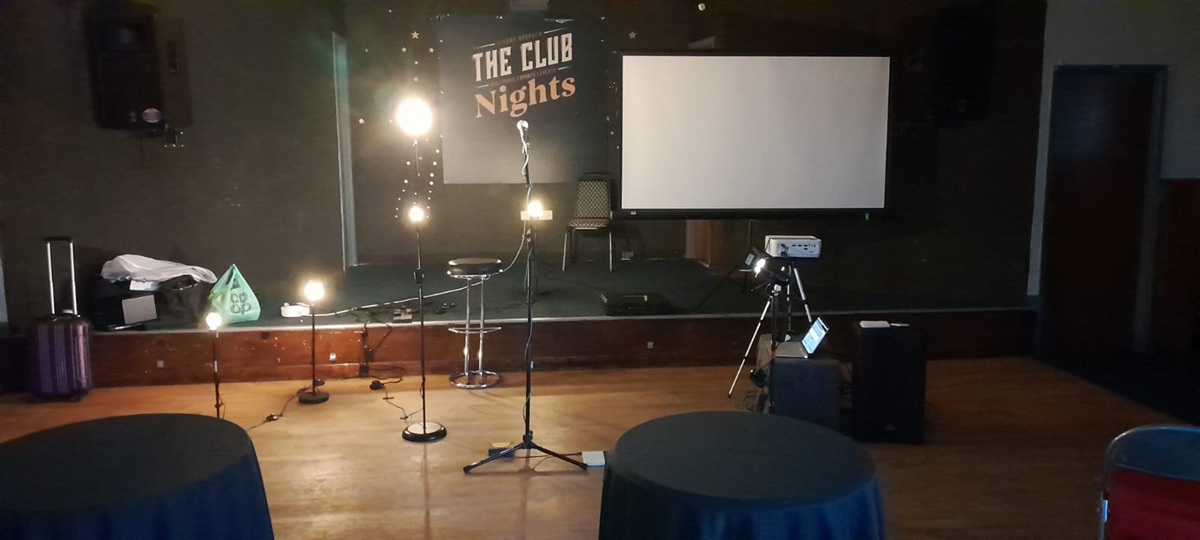
I’ll talk about lighting in the rural touring section – suffice to say that in venues we used 4 lanterns (max) and it looked beautiful. The key is avoiding general cover and not moving around too much.
Tour Booking
This is a really tough gig. It starts off soul destroying – noone replies, straight no’s – then you have a few wins, then a long long silence, then a few wins, then lots of rejection. You have to have a thick skin. What is curious is the lack of consistency across venues. One venue said no because they’re watched the video and it wasn’t for them – I looked at my video analytics and it remained on zero. One venue said we’ve got too much similar work – I said “about dogs?” and they said “yes” – fast forward and their programme is entirely dog-free. One venue said, very specifically, that they do not book shows unless they’re within, let’s say Merseyside – yet when their season was announced… You guessed it. There were some who got in touch and were dead excited and then ghosted and some who had a phone call and it led to rural touring… Also when you see my tour list below check out where I didn’t tour…
Rural Touring
Rural touring is fantastic. I’ll be honest I was incredibly dubious and then Kate Lynch from Highlights came to see the show, we had a zoom chat and she persuaded me I’d enjoy it. She was right. There’s a lot of snobbery I suspect about gigging rurally opposed to in theatres, but it really is far more fun. Lovely people, warm rooms, nice audiences, frequent raffles, offers of soup and a closeness and connection to an audience that is stronger (I think) than in venues. You’re in their front room, it’s like hanging out with friends.
It does come with challenges though – not least technically. You have to tour your normal kit plus lighting and sound, and it all has to be operated by you (no venue tech’s to bail you out). I bought a powered speaker, Beta 58A Mic, lots of old Ikea Holmo lights (which I retrofitted with faders), a PAR16 mounted on a mic stand, a myriad of cabling, and, frankly, prayer.
I went into the first show not certain whether what I’d bought would do the job. It did – it was simple, based almost entirely on practicals rather than theatrical lighting, but worked nicely. I decided that I’d buy the kit rather than borrow and rent so that if I tour again it’s a cost that I don’t have to return to. Rural touring, all in, made me around £40 for 3 dates. If I do it again though, that figure will change to £600+ because of the investment this time round.
Also, worth saying that I got everything PAT tested which was a fucking nightmare. Trying to find a reasonable quote for 30 items (£400 mate?). Luckily I found a bloke who’s semi retired and still does it on the side and is, I can safely say, a lifesaver.
Money
Everyone always wants to know a little about the finances of this stuff. So I did 14 dates in total, of which one was a fundraiser, one was a 50/50 split because I like the venue and another was a WIP where they took the box office but gave me a room for 2 days to rehearse in. Audiences ranged from 15 people to 114 people with an average of 42.9 per venue and a total audience of 601 (for comparison my average for my first tour was 15.8 people and the second tour was 37.7 people (albeit with half the venues).
Income from the box office will be around £3.2k (or £228 per performance), and the expenditure will be around £2.1k, leaving a balance of about £1.2k in “profit”. I’ve popped profit in inverted commas because at no point yet in the scenario have I paid myself, but also there was kit purchased in the last financial year for this show (PolyEnd Play and Looper) which reduces this – if we’re just looking at it on a project basis then the profit is around £600 (I resold the looper when I realised it wasn’t going to work). I also had to print drafts of the script a fair few times (it’s how I edit the shows and markup for tech) so that takes it to around £560.
Of course the question then becomes what’s my hourly rate?
So each performance day is from 2pm to 10pm, making 8 hours and rehearsals are 10am to 4pm (6 hours). I did 14 days of performance, plus 4 days of rehearsal making 18 days or approx 136 hours. Writing the show took around 50 hours (spread out over a few months), then editing it maybe 30 hours. The music composition was around 8 hours (this was a revelation and very speedy) and then AV design probably another 8 hours. Finally the show assembly on Show Cue Systems was around 12 hours to fully nail it. Tour booking you’d add 10 hours, admin (writing risk assessments, finding kit etc…) maybe 6 hours. So a conservative total of 260 hours work spread across evenings, weekends, days off and then holiday days across a year and a half.
The hourly rate? Around £2.15 an hour.
Without working full time this is not a viable career choice.
Cancellations
I had to cancel 6 performances out of my original 20 booked (which I was a little gutted about). However looking back they were for fairly good reason.
- Cancellation #1 – Cancelled because the promotor disappeared, had their ID stolen, didn’t reply to any communications for 3 months and then moved to France. Not my fault.
- Cancellation #2 – Cancelled because they’d sold 1 ticket the day before the gig and it was a 400 mile round trip with no guarantee.
- Cancellation #3 – I had a chest infection (caught from my toddler son) and couldn’t speak.
- Cancellations #4 – #6 – I got tonsillius (and still am recovering) and couldn’t speak.
It’s one of those things with solo touring – there is no safety net. What I will say however is that with all the venues I had to cancel through illness they were all, without exception incredibly kind and supportive. I think key is being upfront – not leaving it too late, and being very honest. It was shitty to cancel, but they made me feel less bad (as did paracetamol and ibuprofen).
Marketing
I’m going to write less about this than you might think. I did bits of targeted social media advertising, the usual resources, some artist videos etc… However… The most valuable marketing decision for this show was the title. Choosing something that was fun, a bit more relatable, something that had joy implicit in it, but also that opened up a myriad of potential audiences was invaluable.
The show image was probably undercooked (it was a random photo my partner took), and certainly I’ve not solved the conundrum of how to describe what I do. Storytelling seems to be a bit off putting to people (and they don’t really know what it is), it’s not comedy in the classic sense (or certainly that feels like a mislabel), while dramatic the comedic and storytelling element render that less valuable, finally “theatre” feels so generic it hurts. At the core is a show whose identity is split across multiple genres and the lack of a clear focus I suspect is sometimes to the detriment of persuading people taking a risk.
However, with a lack of understanding and preconceptions you also get credit for surpassing them by virtue of being unexpected. The bigger issue longer term is around my identity and brand and how to build a critical mass of people to see my work to get that average capacity from 42.9 (not financially sustainable) to nearer 150 where the dynamic starts to shift.
Oh and I need to redo this website but, sadly, didn’t have time (see above).
The Venues
I wanted to make sure I recorded a little about each of the 14 gigs I did in the end – partly to commit them to a more permanent memory – but also I have a terrible habit of only remembering the bad gigs, or, worst, misremembering I even did it. Also worth saying that universally everyone who runs these venues and the technical teams are an absolute delight.
- Lawrence Batley Theatre, Huddersfield
The cellar is a brilliant venue. Low vaulted ceilings so the sound bounces beautifully, every laugh or emotional moment feels amplified. The audience are incredibly close which is wonderful. I’m a firm believer that hard walls, low ceiling and an audience resting their beers on the stage is best. Someone spilt a beer pre-show – I cleaned it up – that kind of gig. Someone brought a baby (very lovely) and my mate Maya cried and then told me off for that. - 41 Monkgate, York
Again a lovely studio space – they’ve made some changes to the audience layout so the audience feels really connected and it’s got a really great lived in feel – I’ve got a real fondness for venues with posters spray mounted on walls – you can taste the history. - Neuadd Dwyfor, Pwllheli
This is the second time I’ve been here and it’s always lovely – it’s a quite grand theatre with an insanely high stage – I’ve always sold fairly poorly here, so I’m incredibly grateful they still book me. It was also the longest theatre venue get out as we were waiting for 23 minutes for someone to write the feedback card (very appreciated). I should have got a kebab after the show and didn’t. It’s a regret I’ve made twice now. Also I need to gig there in summer where it’s not gale force winds and driving rain.
- Unity Theatre, Liverpool
This was a free show for Unity (so they took 100% of the box office) and was really nice. It’s curious visiting theatres you grew up with and then rediscovering them. I remembered Unity as being a big studio, and now, when I stood on stage, it felt, intimate, close. The result of gigging in lots of places I guess. I did my first stab at a show preview here back in 2014/15 so this was a lovely round circle moment. It’s also recaptured a warmth that had been fading as I left which was really lovely. - Stage @ Leeds
University venue, a small black box theatre with really high ceilings. It was nice if fairly sparsely attended. Leeds University is a real literal and metaphorical rabbit warren – I made the mistake of parking miles away and then having the trapse my kit up 1,000s of stairs. I’ve also realised that the long drives home are getting harder than they were in my 30s – I can manage about 2.5 hours but not really any more. I think this was one that might have been good as a midweek matinee linked with a workshop. - Aberystwyth Arts Centre
I love this room. The studio is round, the curtains don’t quite close properly, the lighting is average and the sound system is average, the dressing room is 95% chair storage. But the room is epic. It was probably my favourite of the theatre gigs. The audience are so close to you, but they’ve done a really nice and subtle rake for them (that feels natural). The curve of the seating block makes it easy to connect with audiences and when you get a laugh (much like Huddersfield) it bounces like a dream. Also a young technician who played a blinder and nailed the ending of the show. - Torch Theatre, Milford Haven
I’ve got a soft spot for The Torch. It’s one of those venues that is just a little insane – a product of a time, probably the 1970s where someone said “let’s build a venue directly on a cliff edge” and noone thought “really, are you sure?”. The space is nice, the sound is crisp and clear, but it’s also quite a dead room. I was performing on Valentines evening and there were clearly some people there who wanted a nice night of theatre and got, well, me. A big laugh at the end when I told the audience I hoped they had both an enjoyable and successful remainder of Valentines. Poor word choice. - Harrogate Theatre
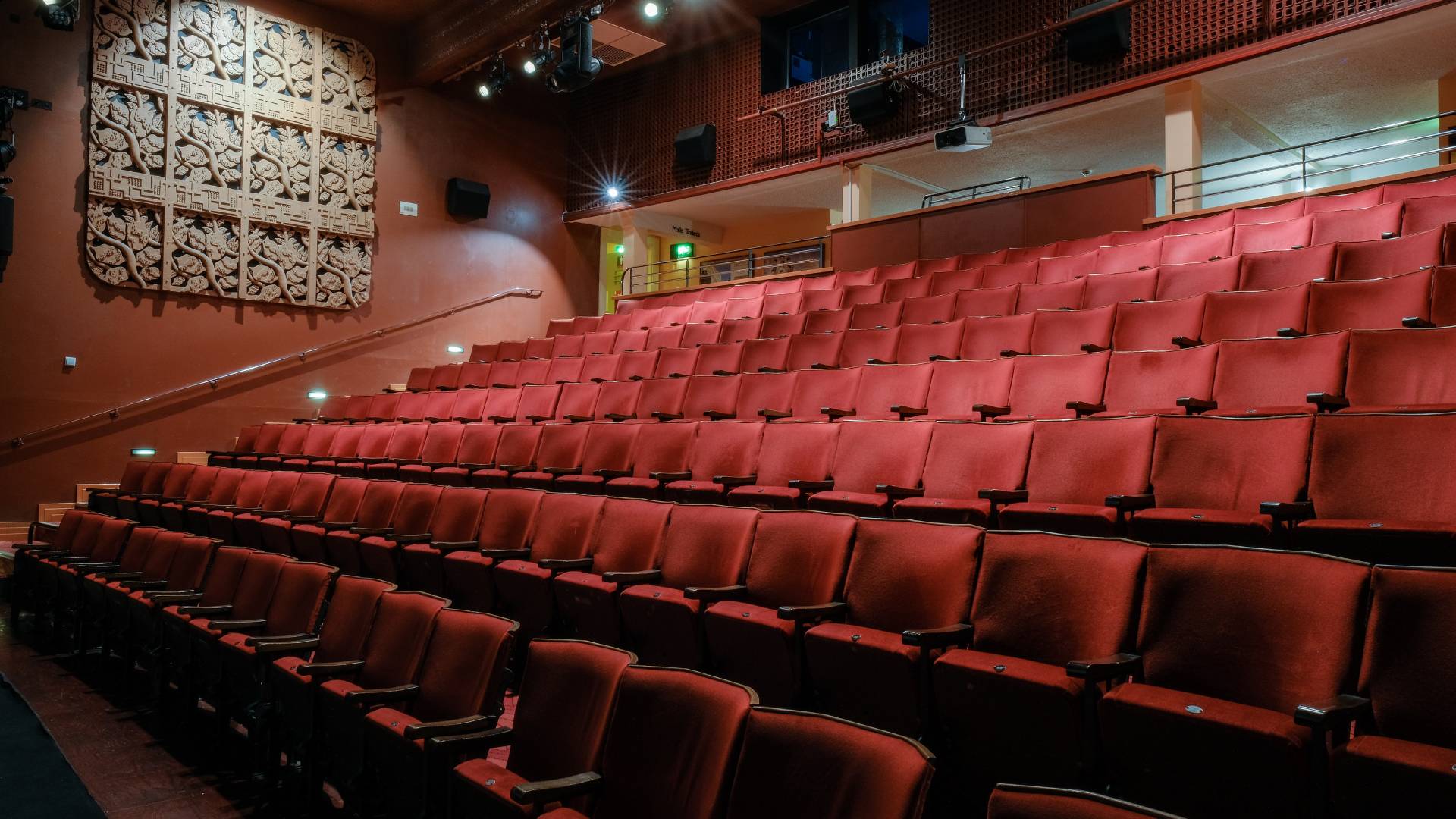
A nice tight black box space with the coldest dressing room and toilet in the world. The show was lovely, audience good and close, and a low hard ceiling. The dressing room was freezing though and I spent a chunk of the day wrapped up in my coat shivering. As I came offstage I overheard a woman at the back of the theatre say “that was much better than I expected”. Thank you Harrogate.
- Stephen Joseph Theatre, Scarborough
This was the venue I was most anxious about – I grew up with this theatre, my first job was here and it is, as an arts organisation, my first love, so to speak. I was performing in the McCarthy which was lovely, a nice warm room with a really good relationship to the stage. I was, I must confess, expecting to know 100% of the audience but, as it happens, it was maybe 30-40 people I knew. It was the biggest crowd of the tour and my head was worrying that it wouldn’t translate from a 30 – 50 seater into a room with 100+. As it happens it was lovely. - Alphabetti Theatre, Newcastle
My first time ever gigging in Newcastle. Alphabetti is a really interesting venue. A fabulous tone and feel with a lovely front of house. The theatre is slightly odd in its configuration – two unequal blocks of seating with a door, tech desk and huge gap where the stage’s traditional centre line would normally be. I struggled performatively at this gig, and, it was one of those rare occasions a critic was in. I’ve popped the review further down which is, it’s fair to say, nice. Oh and a really joyful team working there who just need that bit of funding to make life easier. - Theatre By The Lake, Keswick
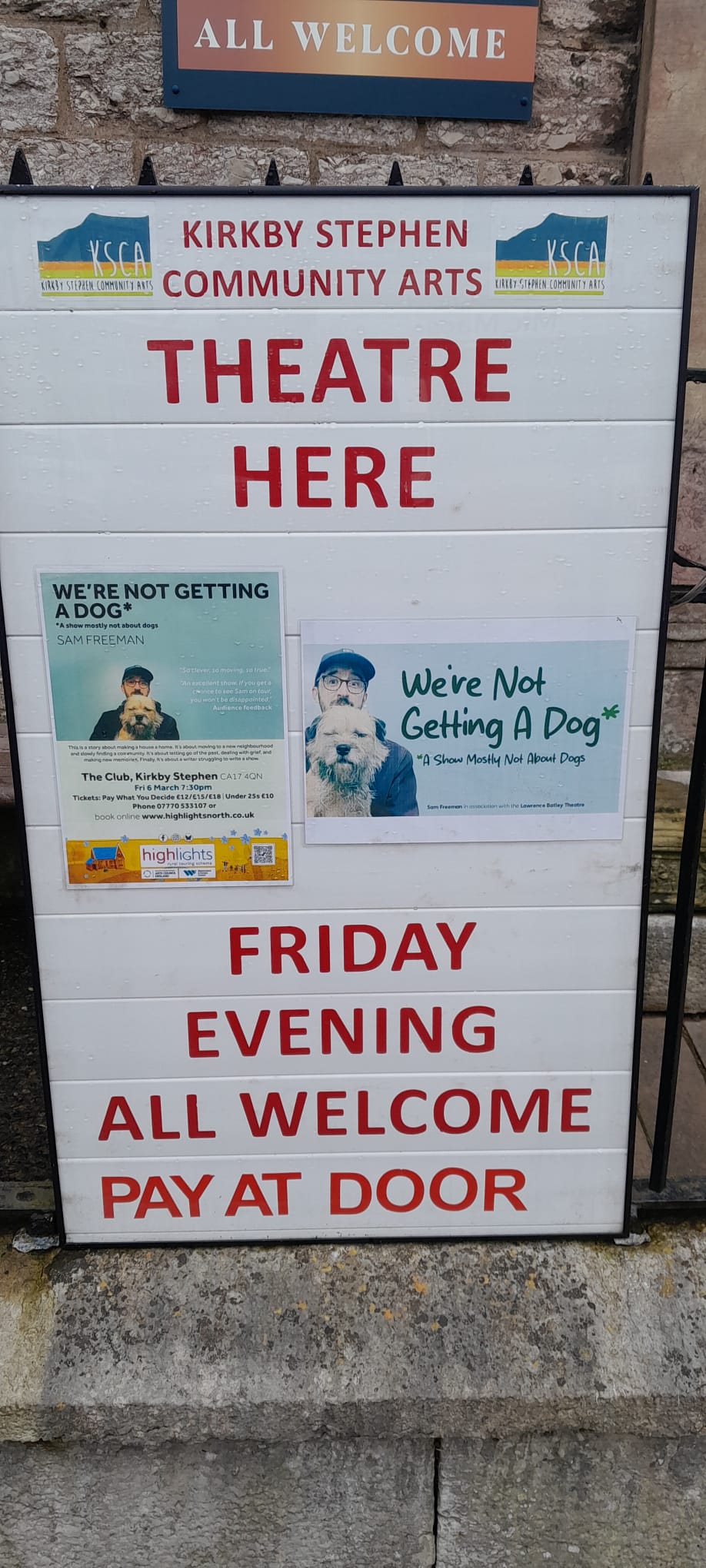
What a view! Literally the best view of any theatre in the UK. The theatre itself is cosy and was a couple of seats off sold out. A soft finish black box that absorbed the sound – it was nice, with good reaction but the sound didn’t bounce round the venue in the way I’d hoped it would. - Rural Touring – Kirby Stephens
A lovely gig in the upstairs room of a social club. This was the first gig with all my own sound and lighting kit. It was lovely although there’s an expectation of there being an interval and then something else. I did a Q&A and then a rude-ish story I wrote 12 years ago. The Q&A was okay but the story was a misstep. I think I need to think a little about the interval thing and how to introduce that as lots of venues rely on it for income. - Rural Touring – Levens
My favourite gig. A tiny room – imagine half a badminton court. “How many can you get in here?” I asked on arrival, “At most 50″ came the reply as I looked at the room and wondered where 50 people would go. Total sales: 57. Absolutely banging. - Rural Touring – Stanhope
My final gig although I didn’t know it at the time. This was lovely, friendly and warm. We rigged a raffle, I got a geology-based heckle at the start before I’d even begun (dealt with through the rigging of a raffle), a dressing room made of two bedsheets on a rope and promoters who were an absolute delight. Rural touring is brill. Oh, and a massive church hall that’s in the process of being sold so the gig might disappear (which would be a real shame).
Feedback
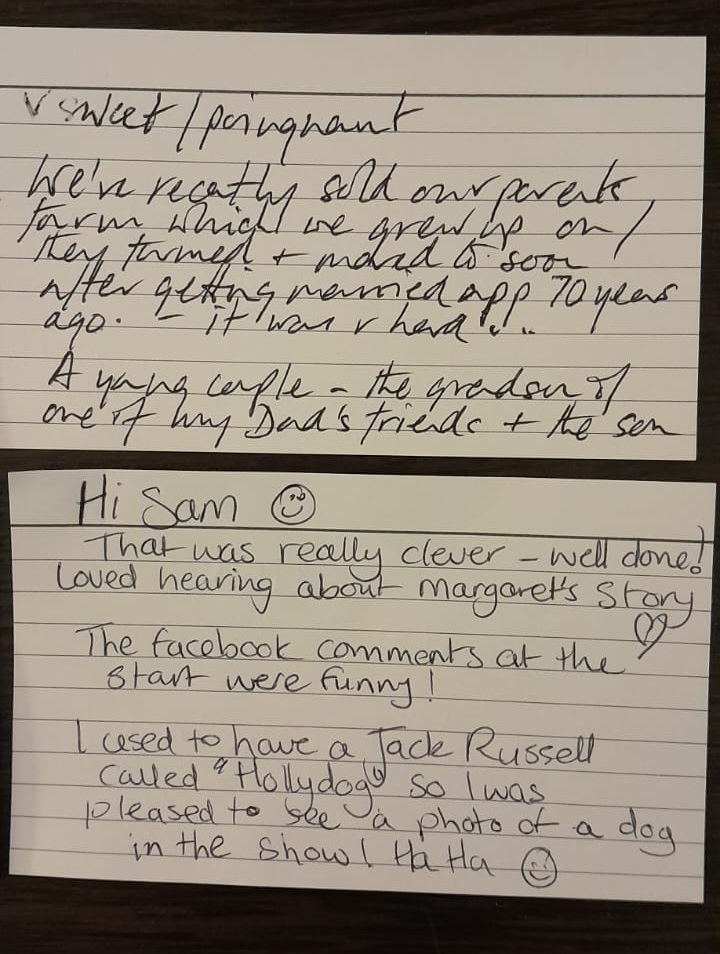
After every gig I left comment cards at the front of the stage to get audience reactions. I get asked intermittently from theatre companies about post-show surveys and sending them via e-mails and I’ve never understood why they don’t just ask people. It’s fine to break the fourth wall when the show has finished and tell people what you need them to do next. The cards work really well so long as you’ve enough pens. That is crucial. I’ve got about 60 photos of multiple feedback cards. The other way (as you asked) is to tell people there are business cards with Q&As linked to a QR as they exit as that gets a very high response rate.
Key learnings: Put them by the door on a table so people can see them and have space to fill them in. Have enough pens and make sure they work. Make sure it’s clear where people leave them.
Reviews
I tend, when I remember, to ask venues not to let reviewers in on comps. Anyone who pays can review but I find the idea of courting praise through a freebie a little grim (although, curiously, not when I’m doing my day job). The reason is fairly simple – I do this as a way to relax and keep doing something creative, not a a commercial venture (see the money section above). I got an epically bad review when I was in my mid 20s and then didn’t do anything creative for about 5 years – each time I though about directing or writing I’d remember that review.
Anyway, two reviewers came on comps (I’d not told the venues). One of them didn’t write an article, but, hopefully had a lovely night out on my dime. The other reviewer wrote, well, the nicest review in the history of the world. Before you read it I just want to say that I was having a shitty day when I read this and it made me cry. Actually cry. It’s here…
NORTHERN ARTS REVIEW
Review: We’re Not Getting A Dog at Alphabetti Theatre
By Lauren Powell
We’re Not Getting a Dog, a show with minimal dogs, some Ewan McGregor and absolutely no asthma on a good night is a one-man masterpiece. It’s rare that I leave a show with absolutely no negative opinions, no niggles, not even any constructive criticisms. This 60-minute monologue was perfect. (even if there was no intermission – IYKYK)
Sam Freeman opens with a bit of banter. Before the doors even opened, I noticed him walking around the bar chatting to people, making people who came on their own feel welcome, chatting up the bar staff and so on. “What a canny bloke,” I thought to myself. Behind the mic, he opens with a bit of scene setting that I’d describe as stand-up adjacent. Then he launches into the most relatable account of a period in his life when he moved into a new neighbourhood. From buying a structurally cursed house to quirky neighbours, I saw myself and my partner in different skins. The story is cosy and familiar, and as he weaves in the lives of the people around them, I began to recognise other people I know. This list of doggy demands was identical to my mum’s before she got her dog. The old lady threatening to die at any minute could have been my gran.
Now you might think that sounds a little dull, you might even think, “I don’t need to leave my house to see people I know, I can’t get away from them already!” but it’s the way it’s told. Sam utilises a pedal and a projector to illustrate his tale. He weaves in and out of his story, slotting in mysterious and haunting family photos, pre-recorded voiceovers to tell a parallel story, and illustrated images to tell another. This dynamic storytelling device sucks you in. It makes you want to know more, to keep you intrigued and, as the photos are revealed, it acts as a countdown to the climax. Sam also occasionally breaks the fourth wall, addressing the audience directly. He’s a master manipulator – he gets you to like him and then, before you know it, you’re also fond of his neighbours and you start to see where this story is going.
I must say it matters where you sit. Our original seats would have had us situated almost behind the projector screen, and you really need a good view of it to get the full effect. Lucky for us, there were some empty seats we scooted into, so we got the full effect. The intimate nature of the Alphabetti is ideal for this sort of show, though. It’s truly something to be a part of an audience that felt so unified in the experience of attending this show. We’re Not Getting a Dog has a dream-like quality to it: it’s people you know but don’t know, it’s fragmented, it’s now and yet somehow nostalgic, it’s full of the moments of joy and connection we find in our daily lives and equally about loss and the absence that make these things meaningful.
At the conclusion of the illustrated story, I couldn’t help but start to cry and even now, as I’m recalling the stories to write this review, I find my eyes are damp all over again. 2026 is young, but if I find a show I am more moved by this year, I’ll be surprised. If you get a chance to see this, do not miss it, I don’t think I can be more clear, it was perfect. My editor occasionally allows me a cheeky 6 out of 5 stars for such shows. Forget the elusive 6 stars – this deserves a 10 (Ed. note: I’m being mean and only allowing 5!).
Click here to read
Who am I?
I’ve reached an interesting point with my hobby career where, I think, I may actually be quite good at it. There’s a curious question about what this means for me – do I try and pursue it or do I keep doing what I have been, knocking out a nice show every two years for 10 – 14 performances. The real challenge I think is that in terms of commercial headroom I don’t think what I do has any without me making some significant shifts in what else I do to try and develop my profile. How do you build an audience for an individual artist whose work is not purely comedic, is long-form, relies on structural cleverness to bring the audience in and, the artist isn’t famous, young, dynamic, press worthy etc…
I’ve decided I’m going to do a bit of an exercise in coming up with a personal brand approach and also thinking about a content and audience building strategy for the next 12 – 24 months. I want the next thing I do to be hitting 100 – 150 audience size (which is a fairly substantial jump from where I am), and so to do that I think I need to be far more disciplined and strategic and, crucially, treat myself in a marketing way in the same way I would if I were asked to do the same thing with someone else.
It’s easy doing it for other people. Much harder doing it for yourself.
What Next
I have a bit of break planned for a month or two. Creatively I’m not sure I’ve got any leads out of this tour. Three creatives/leaders from theatres came to see my work (thank you Chelsey, Kate L and Becky – it means a huge amount), but I’m not (and have never been) being asked to “have a chat about what next” – that’s the price you pay for being a lone wolf. The stuff that’s in my head is…
- A storytelling version of A Christmas Carol. The twist being that it’s about an elderly woman called Carol walking out on her life at Christmas to find out who she really is.
- A show called (at the moment), “365 moments of joy” which wouldn’t be read but would be more stand up based – but sat down, with projection and a soundtrack and emotional arc.
- Diary Of A Neurotic New Dad – something I’ve toyed with but I can’t quite find a way of it not being shit and obvious.
- Recording a series of fake podcast travel/history documentaries for Spotify. Essentially the idea would be going to a place for 3 days and recording an episode that’s funny but also documentary style. a bit like Mark Steel’s In Town but not stand-up.
- Reworking my first two shows so that I’ve a trilogy of shows that are good and tourable. Cutting 20 mins from show one (Every Little Hope), renaming it (so it sells more tickets) and then also redoing the sound and AV. Then cutting 10 mins from show two (Every Time I Close), renaming it (so it sells more tickets) and also redoing the sound and AV. Essentially trying to make sure that all three shows feel consistent, have a similar DNA and feel of equal quality.
- I’d also love to write a panto.
If any of this sounds interesting by the way then do get in touch.
Breakdowns
I’ve alluded to this a couple of times. Basically I was signed off work for a month or so with anxiety and depressive disorder late last year. A combination of some fairly poor choices about how I work (obsessively) and how long I was working (there were a couple of 60 hours weeks clocked), but also the cumulative stress of doing a fairly intense job at a fairly intense time for a fairly long time (I’ve been a Director Of Marketing for 10 years now) and now also doing that with a toddler and sadness. I’m writing a proper blog about it, and also about stress in Arts Marketing and the Capacity Crunch. I’m also looking at how I make some chunky changes to avoid it ever happening again (so that I can do more of what I enjoy – making arty shows about dogs).
And Finally…
That’s it really. I hope this has been interesting and/or useful. If it has then please leave me a comment or drop me a line on LinkedIn. Blog writing is very much whispering into the void – sometimes it’s lovely when someone whispers back.
I’m so sad you never made it to The Old Town Hall, I know the audience would have been delighted to see you and I hope you would have had a genuinely heartwarming experience.
I enjoy your writing and your honesty and I wish more people in this industry were like you. Hopefully in our own way we can continue to chip away at the mystery and open up this artistic world to more people who have a story to tell.
You would be welcome (back, sort of ) to the The Old Town Hall in the future and if you ever need a space to work up an idea, I’m sure I could make that work.
Looking forward to the next blog post… Thanks!
Lovely post Sam, and the show was really well received in Harrogate! I will make sure more heaters are put in the dressing room next time! We would love to have you back again